Introduction
In the landscape of higher education, particularly within faith-based institutions, curriculum design serves as the architectural blueprint for student learning. It determines not only what knowledge is imparted but how it is structured, connected, and applied to real-world contexts. At Missional University, a pioneering online institution dedicated to equipping students for the missio Dei—God’s redemptive mission in the world—the choice of curriculum model is no mere academic exercise. It is a strategic alignment with the university’s ethos of holistic, integrative formation that transcends traditional silos.
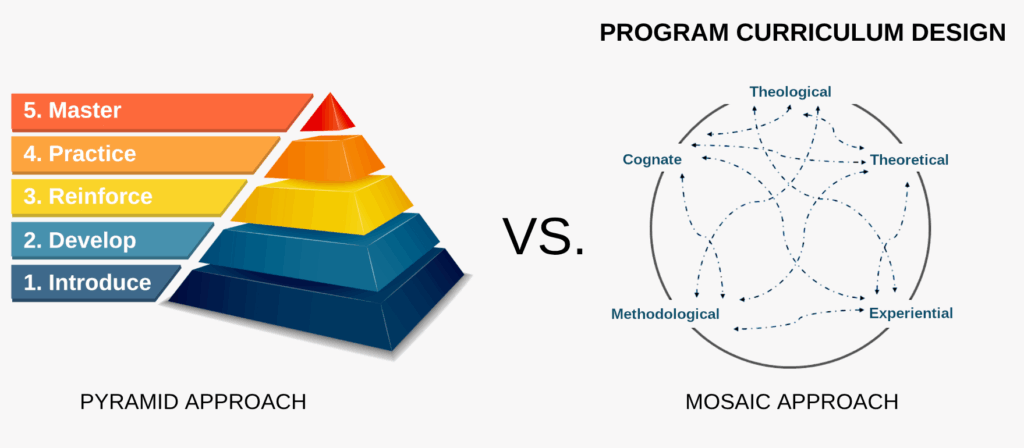
Two primary approaches dominate contemporary curriculum discourse: the Pyramid Curriculum Design, often termed the “linear approach,” and the Mosaic Curriculum Design, known as the “nonlinear approach.” The Pyramid model envisions learning as a hierarchical edifice, where foundational blocks support progressively advanced layers, culminating in mastery. In contrast, the Mosaic model assembles learning like linen cloth, woven with interconnected threads from diverse sources to reveal a unified, multifaceted whole. Missional University predominantly employs the Mosaic approach across its programs, as evidenced in its Missional University Catalogue (Missional University, 2025), reflecting a deliberate commitment to fostering missional practitioners who can navigate complexity with theological depth and interdisciplinary agility.
This article delves into the nuances of these models, drawing illustrations from the Missional University Catalogue to highlight our application. By examining specific courses and programs, we will illuminate the Pyramid’s strengths in sequential skill-building while underscoring the Mosaic’s superiority in equipping students for the missio Dei. In a world marked by cultural fragmentation, ecological crises, and spiritual pluralism, the Mosaic approach emerges not as a novelty but as an imperative—one that mirrors the Trinitarian relationality at the heart of God’s mission and empowers graduates to engage redemptively across boundaries.
The Pyramid Curriculum Design: Building Foundations Layer by Layer
The Pyramid Curriculum Design is rooted in the classical educational paradigm of progression, where knowledge and skills are acquired in a deliberate sequence, much like ascending a pyramid’s tiers. This linear model assumes that mastery of basic concepts is prerequisite to advanced understanding, ensuring stability and depth in skill development. As described in educational theory, it aligns with Bloom’s Taxonomy, moving from lower-order thinking (remembering, understanding) to higher-order applications (analyzing, creating) through scaffolded reinforcement (Anderson & Krathwohl, 2001).
At its core, the Pyramid begins with an introductory course that orients learners to the subject area. Prerequisites may be enforced to gatekeep progression, preventing gaps that could undermine later learning. Subsequent courses develop and reinforce concepts, with each layer building explicitly on the previous. Practice components—often embedded or standalone experiential courses—allow application, leading to a capstone project where students demonstrate integrated mastery. Assessment is typically summative, measuring achievement against predefined benchmarks.
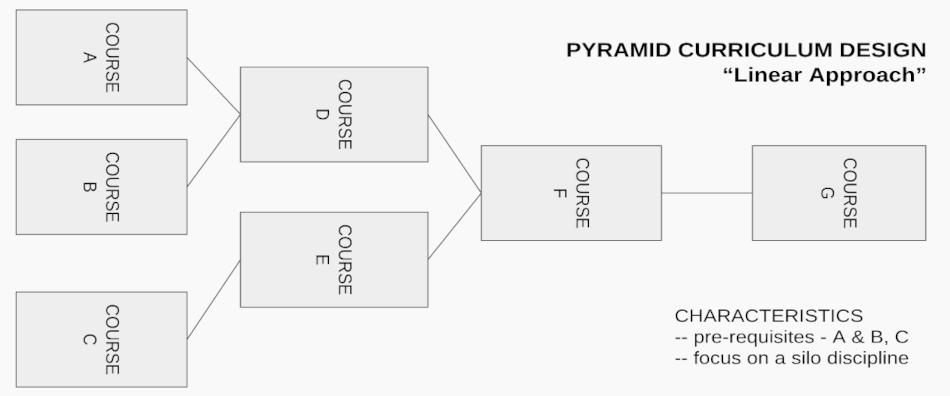
This approach excels in disciplines requiring sequential logic or technical proficiency. Language programs, for instance, demand grammatical foundations before conversational fluency; similarly, STEM fields rely on algebraic prerequisites for calculus. The Pyramid’s efficacy lies in its predictability and measurability, fostering confidence in learners who thrive on structure. However, its rigidity can limit adaptability, potentially isolating knowledge from broader contexts—a limitation acutely felt in missional education, where isolated expertise may falter amid holistic human needs.
Missional University’s Catalogue illustrates the Pyramid model selectively, reserving it for skill-intensive programs where linearity is indispensable. In the School of Creative Expression (SCE), the Digital Arts program exemplifies this. The curriculum commences with MED1000 Intro to Media Studies, a foundational course introducing various media forms and how each medium shapes our social context, experience, and perception. Building upward, DGR2200 Graphic Design for Everyday Life a covers software basics like Adobe Suite and file management—essential prerequisites for all subsequent modules. DGR3200 Graphic Design and Color Theory reinforces visual composition, directly applying tools from DGR2200. Practice intensifies in DGR3100 Digital Illustration and DGR3110 Digital Imaging , where students create integrated projects, culminating in the capstone BMC4970 Creative Expression Bachelor Portfolio or Project, a demonstration project assessed via peer review and faculty critique (Missional University Catalogue, SCE and SEL).
Similarly, in the School of Theological Studies (STS), biblical language programs adhere to Pyramid logic. GRK2110 – Basic New Testament Greek I introduces alphabet, key vocabulary, and grammar, followed by GRK2120 – Basic New Testament Greek II as a strict prerequisite, exploring remaining initial elements of Greek grammar and syntax, and then GRK2130 – Basic New Testament Greek III, where students expand their knowledge of vocabulary, grammar and syntax through parsing and translation. Progression continues through GGRK3110 – Intermediate New Testament Greek, reinforcing parsing and translation thereby adding grammatical and interpretative precision, toward GRK4110 – New Testament Greek Exegesis, where the course employs exegetical methodology to sample biblical texts. Thus sequential mastery ensures exegetical accuracy for missional proclamation (STS Biblical Studies Department).
In the School of Ecological Mission (SEM), the Geospatial Studies concentration deploys a Pyramid for technical precision. GSP2300 – Intro to Geospatial Software Systems lays groundwork in mapping software, prerequisite to GSP3110 – GIS I: Geographic Information Systems and Theory and GSP3120 – GIS II: Analysis and Applications, which builds analytical skills. Experiential practice in GSP3401 – Study Beyond Field Instruction I applies prior knowledge, leading to EEM4970 – Ecological Mission Bachelor Portfolio or Project—a real-world mapping initiative for environmental missions, assessed through technical reports (SEM Geospatial Studies).
Other Catalogue examples include SCE’s Film & Theatre program, with FTH2300 – Multimedia for Everyday Life progressing to FTH3510 – Cross-Cultural Documentary and a capstone thesis film; SCE’s Music & Ethnodoxology, sequencing MWS1200 – Music Theory I to advanced composition; and SEM’s Ecology & Biodiversity, starting with ECO2100 – Intro to Ecological Mission before capstone fieldwork. These programs, comprising about 20% of Missional’s offerings, leverage the Pyramid’s strengths for competency assurance, ensuring graduates possess polished, transferable skills like digital editing or exegetical translation—vital for missional media production or Scripture engagement.
Yet, while effective for isolated skill pyramids, this model risks compartmentalization. In a missional context, where God’s mission integrates creation care, cultural witness, and theological reflection, a purely linear path may produce specialists who struggle to connect their expertise to the broader missio Dei. As we’ll explore, the Mosaic offers a corrective.
The Mosaic Curriculum Design: Weaving Interconnections for Holistic Insight
In stark contrast, the Mosaic Curriculum Design embraces nonlinearity, viewing knowledge as a dynamic mosaic where tiles—concepts, theories, experiences—interlock in multifaceted patterns. Rather than a single ascent, learning radiates from multiple entry points, acknowledging that human cognition often expands associatively, as psychologist Daniel Kahneman articulates. While linear thinking is vertical selecting a pathway by excluding other pathways, non-linear thinking is lateral seeking to open up other pathways in a generative process. (Edward de Bono). It is this lateral, nonlinear approach that is thinking mosaically. This approach thrives on four pillars: theological (rooting in “theology of” frameworks), theoretical (juxtaposing evolving paradigms), experiential (embedding practice amid theory), and methodological/cognate (linking related disciplines).
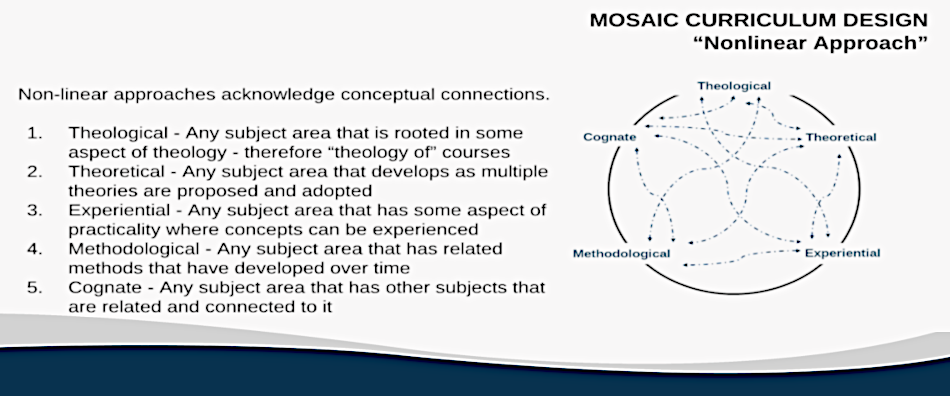
Flexibility is key: prerequisites are minimal, allowing students to enter via personal interests or contexts, fostering ownership. Courses interconnect horizontally, reinforcing concepts through cross-references rather than vertical stacking. Assessment is formative and integrative, often via portfolios or reflective narratives that capture emergent understandings. The Mosaic suits interdisciplinary fields, where siloed learning obscures realities like the interplay of faith, culture, and justice.
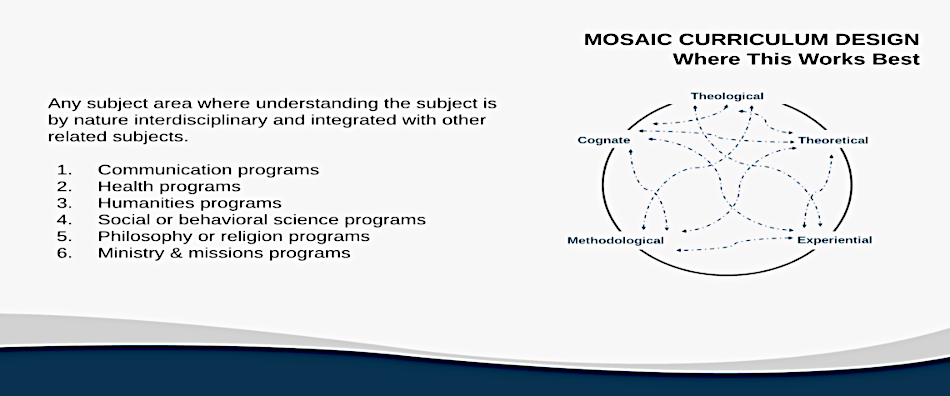
Missional University’s Catalogue positions the Mosaic as the dominant paradigm, permeating 80% of its programs and explicitly tied to its mission: Our nonlinear curriculum reflects the integrated nature of God’s mission, enabling students to form connections that mirror Trinitarian relationality. This is vividly displayed in the School of Intercultural Mission (SIM), where all departments employ Mosaic design.
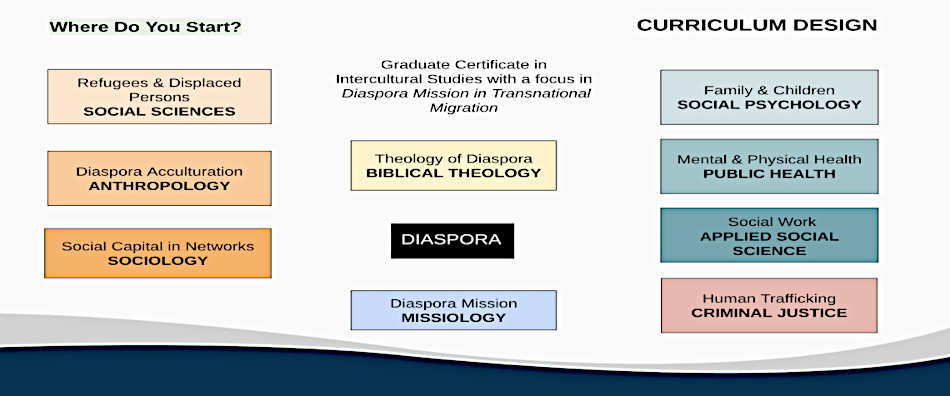
Consider the Global Migration Studies graduate program in the School of Intercultural Mission (SIM). Rather than a linear theology-to-practice sequence, courses form a web: THM5440 – Issues in a Theology of the Diaspora connects theologically to DSP5400 Causes & Consequences of Refugees and Displaced Persons, exploring analytical frameworks for evaluating the situations faced by refugees and displaces persons. Cognate links appear in SWK5310 Mental & Physical Health in Immigrant Communities, which integrates methodological tools from social work with health program methods from SCM, without prerequisites. Students might enter via SWK5300 Family & Children in Immigrant Communities, a theoretical/experiential course on family issues in diaspora communities, then spiral to DSP4100 Disapora Acculturation & Integration Strategies, another theoretical/experiential course that analyzes and interprets demographic data to explore variegated immigration, emigration and living patterns. The non-capstone integration culminates in a portfolio demonstrating missional application across threads under the supervision of the School of Experiential Learning (SEL).
In the School of Missional Practice (SMP), the Transformational Discipleship program weaves Mosaic threads. While THM3410 -Theology of Person & Place centers on a theology of individuality, identity, and community, it intersects with ELD3110 – Foundations of Mission-Shaped Disciplemaking, where students move beyond a one-sided, soul-centered gospel to living out faith in context — growing as a culture-making, disciple-maker in the image of Christ. Experiential depth emerges in ELD3200 – Contextualized Disciplemaking, cognate with SCE’s communication courses, such as COM4110 Communication Theory for Christian Witness, allowing nonlinear progression — students could start with SCM’s practice-oriented PCC3130 Pastoral Care Skills before circling back to foundations. This mosaic integration fosters adaptive leaders who proclaim Christ amid diverse narratives.
The School of Creative Expression (SCE) exemplifies Mosaic Integration in Communication Studies. The STS course, THC3320 – Theology, Media & Communication serves as a theological nexus, connecting to COM3100 Communicating Across Cultures, which explores intercultural communication approaches. Methodological cognates include COM3200 Communication & Media Research & Analysis, blending experiential research with communication theory. Flexibility shines: no strict prerequisites, enabling entry via ANT4200 – Language, Culture & Thought, which evaluates how language shapes thought patterns and everyday communications.
In the School of Community Ministry (SCM), Community Health programs utilize the Mosaic integration of medical theology. TMD3520 – Theology of Illness and Healthcare links theologically to HLT3200 – Principles & Practices of Healthcare, incorporating holistic knowledge in practice. Cognate methods from Social Work weave in without linearity, as in SWK2200 – Cultural Competence in the Helping Professions, where students connect cultural competency to practical health interventions. CHA3800 – Community Health Advocacy & Outreach and CHA4820 – Community Health Capacity Building explore advocacy methodologies that enable decision making and ownership at the local level while promoting the medical care of communities. Nonlinear design equips stewards for integral mission, addressing body and earth holistically – and that is amplified in the community health programs.
In the School of Theological Studies (STS) non-language programs, like Moral Formation, further illustrate: THS4200 Moral Theology & the Missio Dei mosaics with THM3300 – Missional Hermeneutics, bridging missional theology and social theology across STS departments. By identifying issues of morality in the broader society with appropriate educational pathways TMT3410 – Moral Issues and Moral Education interconnects with biblical studies cognates including both BIB3130 – Insiders Versus Outsiders: Early Christian Missional Ethos that discusses navigating identity boundaries, and THM4230 – Sensitivity Towards Outsiders: Early Christian Missional Ethics, how Christians view those “others” who are outside the Christian community. Students could start with SMP’s ELD3200 Contextualized Disciplemaking where the nexus between developing a disciplemaking strategy that contextualizes the gospel within the culture and context, and addressing moral formation in the broader society could merge.
Across SIM, SMP, SCM, SJM and select SCE/SEM/STS offerings, the Mosaic dominates, promoting interdisciplinary mosaics that reflect the missio Dei‘s interconnected redemption. This approach’s nonlinearity mirrors real-world missional challenges, where theology informs immediate practice, and experiences reshape theory—unlike the Pyramid’s staged delays.
Why the Mosaic Approach Excels in Equipping for the Missio Dei
The missio Dei—Latin for “mission of God”—posits that God’s redemptive work, initiated in creation and consummated in Christ, invites humanity into a participatory, holistic enterprise (Bosch, 1991). This Trinitarian mission is inherently integrative: the Father’s creative love, the Son’s incarnational solidarity, and the Spirit’s empowering presence demand formation that transcends compartments. Here, the Mosaic approach surpasses the Pyramid, not by dismissing linearity where needed, but by embedding it within a relational web that equips students as agile agents of shalom.
First, theological rootedness infuses every thread, countering secular fragmentation. In Pyramid programs, theology often tacks on as an elective, risking skills divorced from divine purpose—like digital media without a “theology of beauty,” business administration without a “theology of work,” criminal justice without a “theology of restorative justice,” or social work without a “theology of community and society.” Mosaic programs, per the Catalogue, mandate “theology of” integrations, as in STS’s THE4330 – Theology of the Built Environment, where understanding communities (SCM) emerges from Genesis narratives, fueling urban ecology, applied GIS spatial modeling (SEM), urban mission and city evangelization (SIM), while roping in urban housing and development (SCM) and empowering ministry in residential communities (SMP) all the while intersecting with THM3200 – Urban Theology: Space, Place & the City. This aligns with the missio Dei‘s call to holistic witness (Wright, 2010).
Second, interdisciplinarity mirrors missional complexity. The Pyramid’s silos produce experts who may excel in Hebrew exegesis but falter in cultural translation—a gap in global ministry. Mosaic’s cognates bridge this: SCE’s media ethics draws from STS hermeneutics and SCM psychology, forming communicators who navigate pluralism holistically. Mosaic design equips for integral mission, where health, arts, and theology converge in Christ’s healing. In practice, ECO4510 – Land Use, Legacies and Transformation in Urban Ecosystems students collaborate on climate-health projects (SCM) infused with SIM’s urban strategies, embodying the missio Dei‘s cosmic scope (Newbigin, 1989).
Third, experiential nonlinearity fosters adaptability. Pyramid capstones arrive after years of theory, potentially ossifying learners against change. Mosaic embeds practice early and iteratively, as in SCG2200 – Spiritual Caregiving & the Mission of God, where experiential failures reshape theological understanding—mirroring the Spirit’s adaptive leading in Acts. This builds resilient missional leaders for volatile contexts, like digital evangelism amid AI disruptions, where flexible educational entries allow real-time pivots.
Fourth, formative assessment cultivates reflection. Pyramid’s summative tests measure outputs; Mosaic’s portfolios capture transformative processes, echoing missio Dei‘s narrative arc. Graduates emerge not as technicians but as co-creators in the mission of God, discerning God’s activity in ambiguities—vital for fields like ecological health, where BIO3800 – Biocomplexity & Systems Ecology assesses integrated biological and ecological systems, not isolated data (SEM).
Empirical support bolsters this: Studies show nonlinear curricula enhance critical thinking and retention in interdisciplinary settings (Darling-Hammond, 2017), while missional educators report Mosaic-trained alumni excel in cross-cultural efficacy (Bevans & Schroeder, 2004). At Missional University, among SCE students for example, the mosaic curriculum connects media skills to God’s story, which propels students toward mission on the digital frontier.
In sum, the Mosaic Curriculum’s superiority lies in its fidelity to the missio Dei: a participatory, relational, integrative mission that defies linearity. By weaving theological depth with practical breadth, it forms disciples who don’t just know about God’s work but know how to join it redemptively.
Conclusion
The Pyramid and Mosaic represent divergent visions for education: one ascends methodically, the other expands relationally. Missional University’s Catalogue deftly employs both—Pyramid for skill pyramids, Mosaic for missional mosaics—yet prioritizes the latter to honor the missio Dei. As global challenges demand integrative wisdom, the Mosaic equips not specialists, but stewards whose lives reflect Christ’s seamless kingdom. Institutions aspiring to missional fidelity would do well to mosaic their curricula, ensuring graduates don’t merely build but become the mission.
References
- Anderson, L. W., & Krathwohl, D. R. (Eds.). (2001). A taxonomy for learning, teaching, and assessing: A revision of Bloom’s taxonomy of educational objectives. Pearson.
- Bevans, S. B., & Schroeder, R. P. (2004). Constants in context: A theology of mission for today. Orbis Books.
- Bosch, D. J. (1991). Transforming mission: Paradigm shifts in theology of mission. Orbis Books.
- Darling-Hammond, L. (2017). Empowered educators: How high-performing systems shape teaching quality around the world. Jossey-Bass.
- de Bono, Edward. (1977). Lateral thinking: creativity step by step. Penguin Books.
- Kahneman, Daniel. (2013). Thinking, fast and slow. Farrar, Straus and Giroux.
- Missional University. (2023). 2023-2026 Catalogue. https://catalogue.missional.university
- Newbigin, L. (1989). The gospel in a pluralist society. Eerdmans.
- Wright, C. J. H. (2010). The mission of God’s people: A biblical theology of the church’s mission. Zondervan.
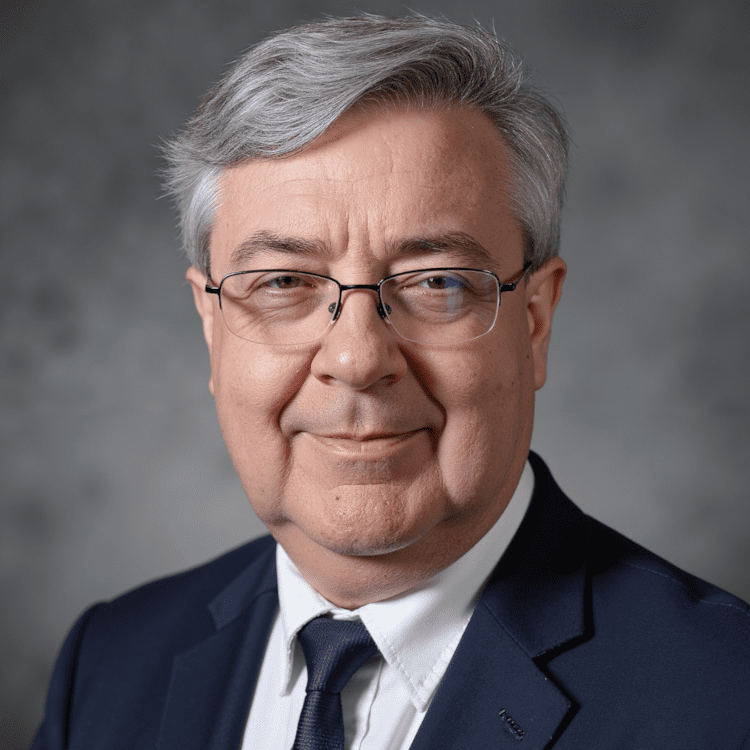
Dr. Curt Watke is a distinguished missiologist whose three-plus-decade-long career has significantly impacted Christian mission work in North America, particularly in under-reached and challenging regions. Holding a Ph.D. in Evangelism and Missions, Dr. Watke has focused on bridging cultural gaps and fostering sustainable Christian communities by developing innovative strategies that address contemporary challenges like globalization, urbanization, and religious pluralism. His emphasis on cultural sensitivity and contextualization in mission work is reflected in his collaborative writings, including notable works such as “Ministry Context Exploration: Understanding North American Cultures” and “Starting Reproducing Congregations.” Beyond his writing, Dr. Watke is a sought-after speaker and educator, lecturing at seminaries and conferences worldwide, and his teachings continue to inspire and equip new generations of missional leaders. His enduring legacy is marked by unwavering dedication to the mission of God and a profound influence on missional thought and practice. Dr. Watke serves as President and Professor of Evangelism & Missiology at Missional University.